Washout detection demonstration video
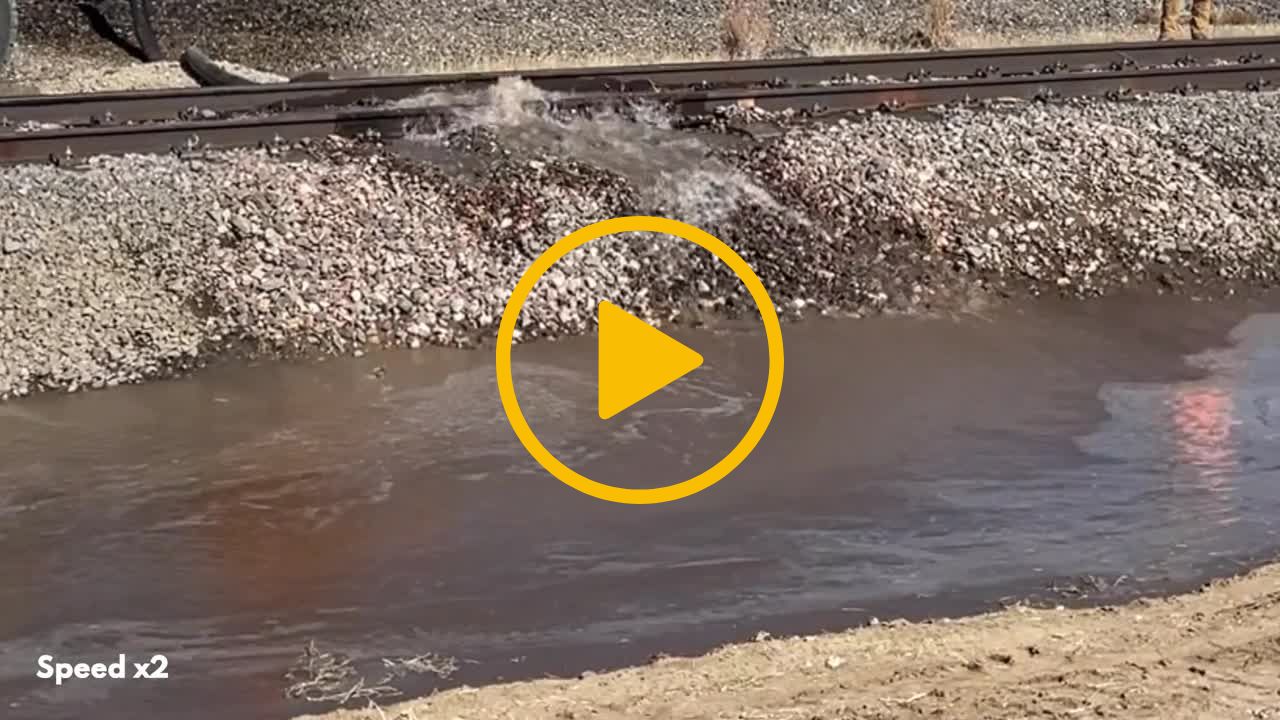
Washouts pose a severe and growing threat to railway safety and operational integrity. Washouts come in two general types. Those that erode and wash away the track bed, supporting structures or materials, and those that cause water driven debris flows of material onto the railway tracks. Both can and have led to catastrophic derailments, endangering the lives of passengers and staff and causing extensive damage to rolling stock and critical infrastructure. The risks increase further for freight trains carrying hazardous materials, potentially causing spillage generating major environmental damage too.
With increasingly extreme and unpredictable weather patterns driven by climate change, the frequency and severity of these events are on the rise. Our Distributed Acoustic Sensing (DAS) technology offers a solution by providing real-time detection and precise location of moving ground and materials across long lengths of rail network. By continuously monitoring the acoustic signatures of moving ground, earth, rocks and ballast, our system delivers vital, near-instantaneous warnings, empowering operators to take immediate action and effectively mitigate these increasing risks when extreme weather strikes.
This application is under development. We welcome enquiries from infrastructure owners/maintainers for further information.
Up to 100km of coverage per unit
Fiber optic sensing, specifically Distributed Acoustic Sensing (DAS), allows a single sensing unit to monitor up to 100km of fiber from a single secure location. That equates to around 80km / 50 miles of rail route that can be monitored for washouts by each sensing unit. No longer do you have to predict where a washout will occur as entire routes can be monitored.
This long-range capability is also essential for remote rail routes where power and communications access may be limited. By centralising monitoring technology in existing signalling or equipment rooms, operators can achieve massive network visibility without the logistical burden of installing and powering thousands of individual point sensors across vast geographic distances.
Weather and interference resilience built-in
Buried fiber optic cables are inherently protected from the destructive forces of nature. While trackside poles, antennas and sensors can be damaged by high winds, lightning, or debris flow, a buried fiber cable remains operational so long as it is not physically severed.
Fiber optics are also entirely immune to Electromagnetic Interference (EMC) from both external and railway sources such as traction power systems, ensuring that high-voltage overhead lines, passing locomotives or even external sources, both natural or nefarious, do not generate false alarms or compromise detection sensitivity.
No gaps in protection
Traditional washout detection often relies on manual inspections or reports from drivers. Point sensors such as tilt, displacement, float or strain sensors can be used to monitor a single specific spot where they are installed, but this makes full route coverage impractical.
Fiber optic sensing turns the entire length of a buried cable into a high-fidelity sensor array, providing 100% spatial coverage along its length with no gaps, and no infrastructure "blind spots." This gapless detection ensures that regardless of where a washout occurs, even in unexpected areas, the system can identify the ground movements from the event, providing superior reliable protection.
No on-site maintenance requirements
A primary contributor to on-site maintenance tasks is the need to replace batteries or reset sensors after a weather event or false alert. Fiber optic sensing requires neither trackside power or batteries, nor regular on-site maintenance. Because the sensing element is a passive glass fiber, there are no components to wear out or require calibration or replacement in the field. This results in a truly scalable, maintenance-free solution that reduces boots-on-ballast time and lowers long-term operational costs.
No Reliance on Radio Communications
Many IoT-based point sensor solutions depend on cellular or radio networks to transmit data and alerts. Those same radio networks are often stressed or can even fail during the extreme weather events they intend to monitor. Fiber optic sensing uses the fiber itself as the data carrier, meaning data is transmitted via light by the fiber to safer and more secure equipment and signalling rooms. This immunity to accidental or intentional radio interference, signal fading, or network congestion ensures that critical washout alerts reach the operations centre reliably, even in the harshest weather conditions.

2026-04-29 · Daniel Pyke · 11min
How can we make smarter decisions about rail weather resilience?
Read more
2026-03-24 · Daniel Pyke · 8min
Do we need more sensors or more sense?
Read more
2026-03-10 · Daniel Pyke · 7min
We can't monitor entire rail routes... Can we?
Read more