How big? Smaller than you think
When earth, mud or stone strays into the rail corridor, it puts passengers, crews and timetables at risk in an instant. The exact threshold for damage from rockfalls and landslides depends on train speed, traffic type and track geometry. But a modest amount of material, in the wrong place at the wrong time, can be catastrophic.
Size isn't everything
A concentrated spread of small stones, or a sudden surge of saturated mud, can be just as dangerous as a single large rogue rock.
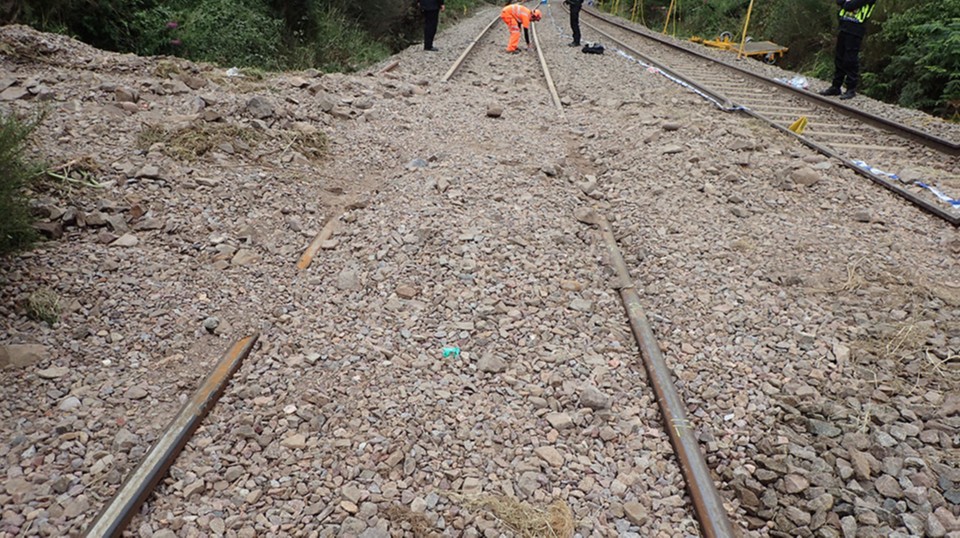 This debris flow accident resulted in the deaths of 3 people, a £6.7 million fine for the network owner and a near £1m compensation bill.
Image from the Rail Accident Investigation Branch report
What Drives Rockfalls and Landslides?
Newton's First Law tells us that an object stays at rest unless an unbalanced force acts on it. On a slope, gravity pulls constantly downhill and friction holds things in place. As long as the two stay in balance, nothing moves. Tip that balance, and the slope starts to slide.
Nature supplies the push. Rain, wind and groundwater pressure work away at rock faces and earthworks. Freeze-thaw cycles prise cracks apart; summer sun heats and expands the rock by day, then cools and contracts it by night. Seismic tremors can fracture rock, or liquefy seemingly solid ground, in seconds.
A changing climate is turning up the pressure. Severe weather is becoming more frequent and more extreme, and slopes that have stood still for decades are starting to stir. Flash floods, heatwaves, hard frosts and swings between flood and drought all shift groundwater levels and weaken the ground.
Once these forces overcome friction, material moves, often fast, and can end up across the track. It arrives in three distinct ways:
- Rockfall - Dropping from above
- Rockroll - Tumbling down slopes
- Rockslide / Landslide / Mudslide - Masses of material on the move
Let's look at each in turn, and at how we help you detect them using fiber optics, the moment they happen.
1. Rockfall: The Long Drop
Where track runs beneath sheer cliffs, cuttings or unlined tunnels, loose or fractured stone can drop straight down onto the line.
That vertical fall is hard for cameras to capture. A metre-wide bundle of vegetation and a metre-big boulder can look alike from a distance, yet only one of them is a terrible threat to train safety. Visual spotting systems see shape; they don't discern density.
Distributed Acoustic Sensing (DAS) works differently to traditional detection techniques: it listens to the ground, so mass matters. When a rock lands, its kinetic energy travels through the ground as a distinct seismic signal. That vibration signature is analysed and recognised in real time, turning it into an automatic alarm. This means your operations team knows the moment something heavy hits and where that threat is, so they can do something about it.
Learn more about how DAS works
2. Rockroll: Tumbling Down the Slope
Many lines follow valleys flanked by steep slopes rather than sheer drops. When weather works a stone loose here, it doesn't just fall. It tumbles, bounces and rolls towards the track. This is the more typical type of rock fall railways encounter as rail routes twist and turn through different terrain.
Every bounce is a beat, as the rolling rock plays its raucous rhythm, striking the slope again and again. This is the train threat warning gong our AI is keenly listening for. Sensing and recognising that seismic signature in real time, we warn rail operations teams in seconds, giving them the time to trigger a response to protect train traffic from taking a terrible tumble.
3. Landslides & Debris Flows: Small Volumes, Massive Impact
Not every earth movement involves large rocks as we saw earlier. Intense rainfall saturates slopes sending mud, gravel, debris and detritus descending onto the track. As weather extremes become more common, so too does this type of geohazard as previously stable slopes become mobile.
The railway risk is real. At Carmont, Scotland, a debris flow (pictured earlier) of just 175 mm (7 inches) deep washed onto the track when a drain was overwhelmed during heavy rain. The derailment that followed cost three people their lives and every passenger on the train was injured. A recent landslide derailment at Shap highlighted shortcomings in the new slope monitoring equipment that has been installed to prevent this type of accident.
Germany suffered a tragedy on 27 July 2025. Near Riedlingen in Baden-Württemberg, heavy rain caused a sewer shaft to overflow, washing material from the railway embankment onto the track. A regional express train hit the debrid, derailed, killing three and injuring 41 passengers.
Once again our sonic sentinel stands guard flanking your railway track listening for this rumble of tumbling material flowing foul onto the track. Using fiber optic sensing we deliver the alerts needed to keep rail traffic from encountering blocked tracks at speed.
Real-time route protection along every metre
Stopping rockfall and landslide train accidents takes continuous, gap-free awareness. We turn the fiber optic cable often already running beside your track into a virtual array of vibration sensors, up to 80 km of route protection from a single sensing unit. Rapid slope movements, rolling rocks and flowing debris show up in real time, with no extra trackside electronics, no batteries and no added maintenance.
Ready to protect your routes with 24/7 acoustic intelligence? Talk to our team about how we can help safeguard your network.