A recent landslide in the UK caused a passenger train to derail, despite local earthworks having remote monitoring fitted to detect potential landslides.
Fortunately, despite the train derailing at over 80mph, it remained upright and no-one was seriously injured.
The Railway Accident Investigation Branch (RAIB) commenced an independant accident investigation, and have taken the unusual step of issuing Urgent Safety Advice to the wider railway industry and suppliers of landslide detection equipment.
The urgent safety advice issued can be found on the UK Government website but we will include and respond to the content within this short article.
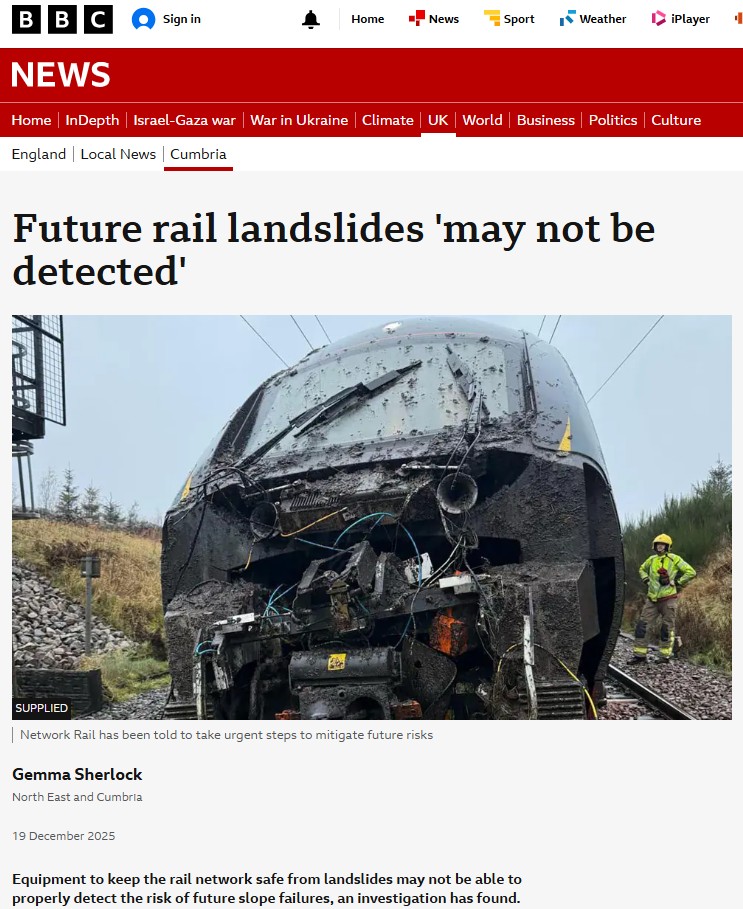 BBC News article highlighting the failure to detect the landslide
As a responsible supplier of railway infrastructure monitoring equipment, this short article addresses the urgent advice issued by RAIB and demonstrates how our monitoring solutions already address the issues the RAIB has identified as problematic.
For clarity it should be noted that Sensonic equipment was not present at the site of this derailment and that our landslide detection works on a completely different methodology, supported by a totally different technology to the monitoring technology present at this accident site.
The text below is taken directly and in full from the urgent safety advice. Emphasis added is our own, and our responses to the advice notice are highlighted.
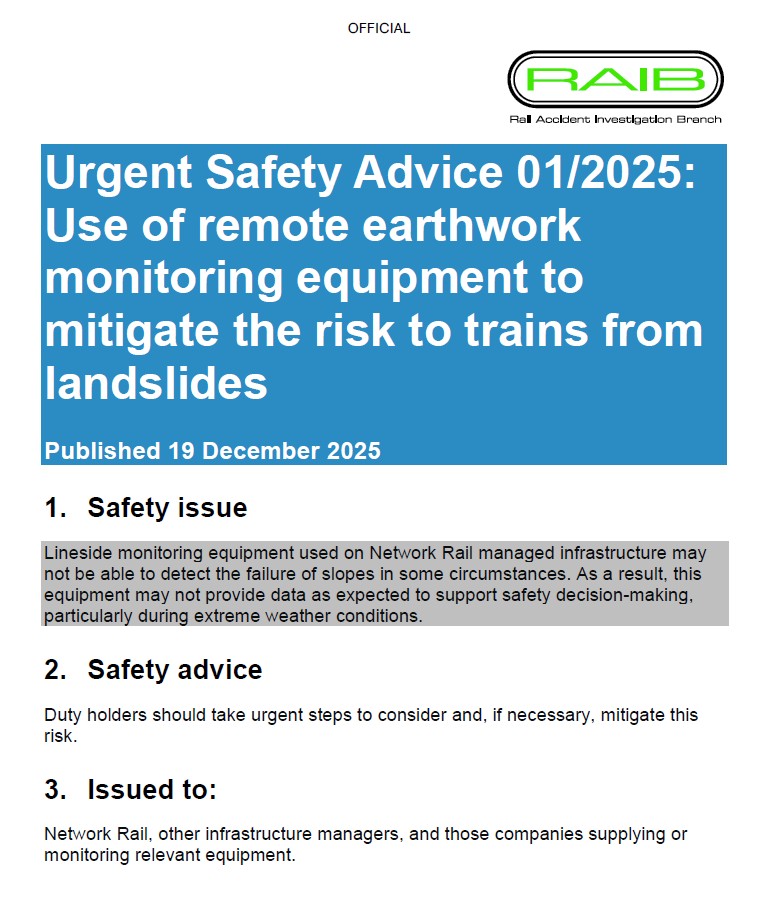
Urgent Safety Advice 01/2025:
Use of remote earthwork monitoring equipment to mitigate the risk to trains from landslides
4. Background
At around 06:10 on 3 November 2025, a passenger train operated by Avanti West Coast, the 04:28 Glasgow Central to London Euston service, derailed after striking a landslip near to Shap Summit, between Penrith North Lakes and Oxenholme Lake District stations.
The train was travelling at around 83 mph (134 km/h) when it struck landslip debris that had been washed onto the track. This material lifted the first bogie off the rails and to the right, where it ran derailed for around 560 metres. There were nine staff and 86 passengers on board the train at the time of the collision. Four people were treated for minor injuries as a result of the accident, and damage was caused to the train and to railway infrastructure.
The landslip was caused by a period of heavy and sustained rainfall. RAIB’s preliminary examination found that a drainage channel, which runs across the cutting slope above the washed-out material, was unable to accommodate the volume of water which was present. This led to the slope material below becoming saturated, initiating the landslip.
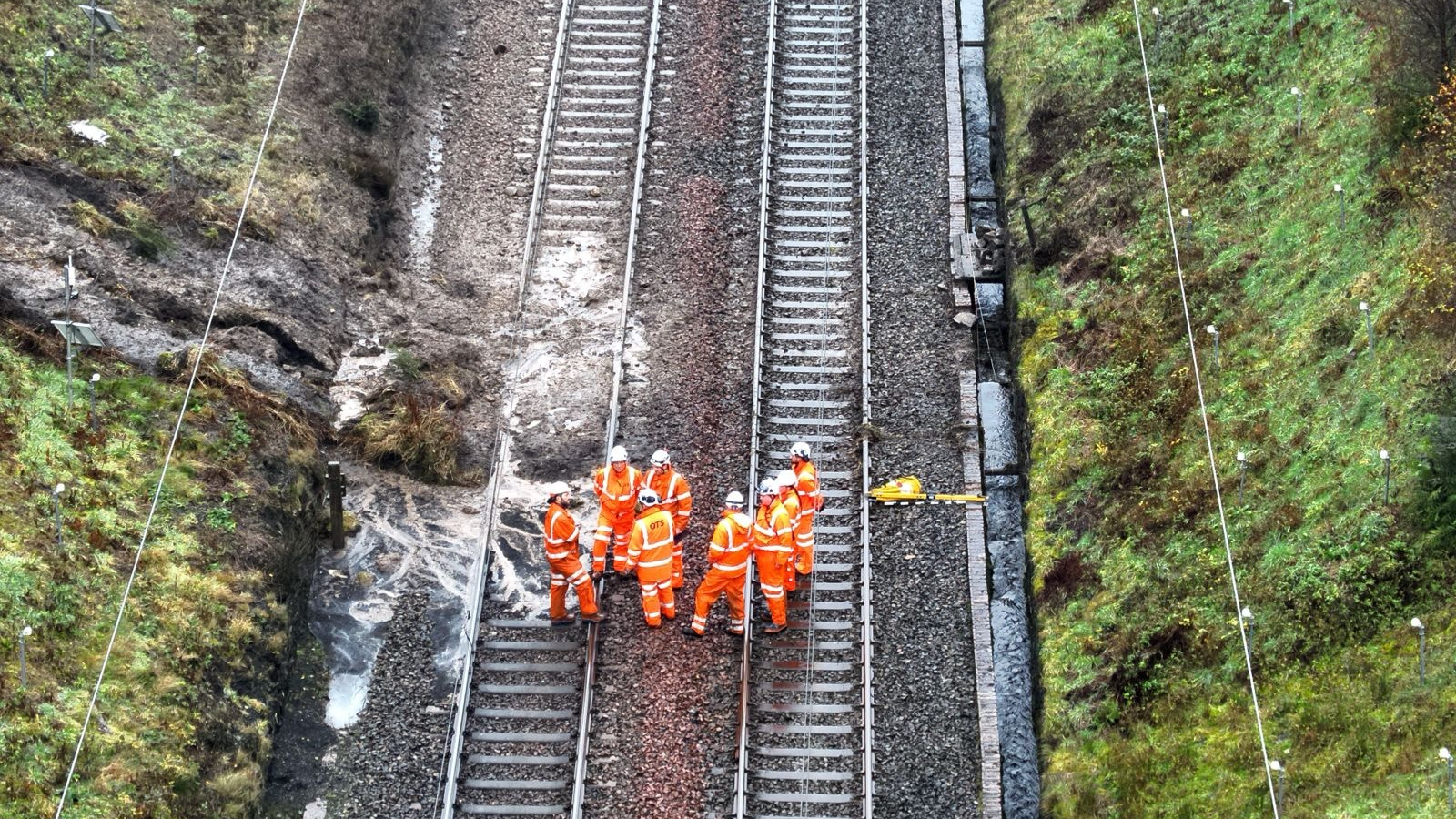 Image from Network Rail
The cutting slope was fitted with remote monitoring equipment, which was designed to detect ground movement. At the time of the accident, the monitoring equipment at Shap was recording data and reporting to its online monitoring service. However, it had not been formally entered into operational use, so was not sending alerts to the Network Rail control centre. Similar equipment is operational on other parts of the railway infrastructure.
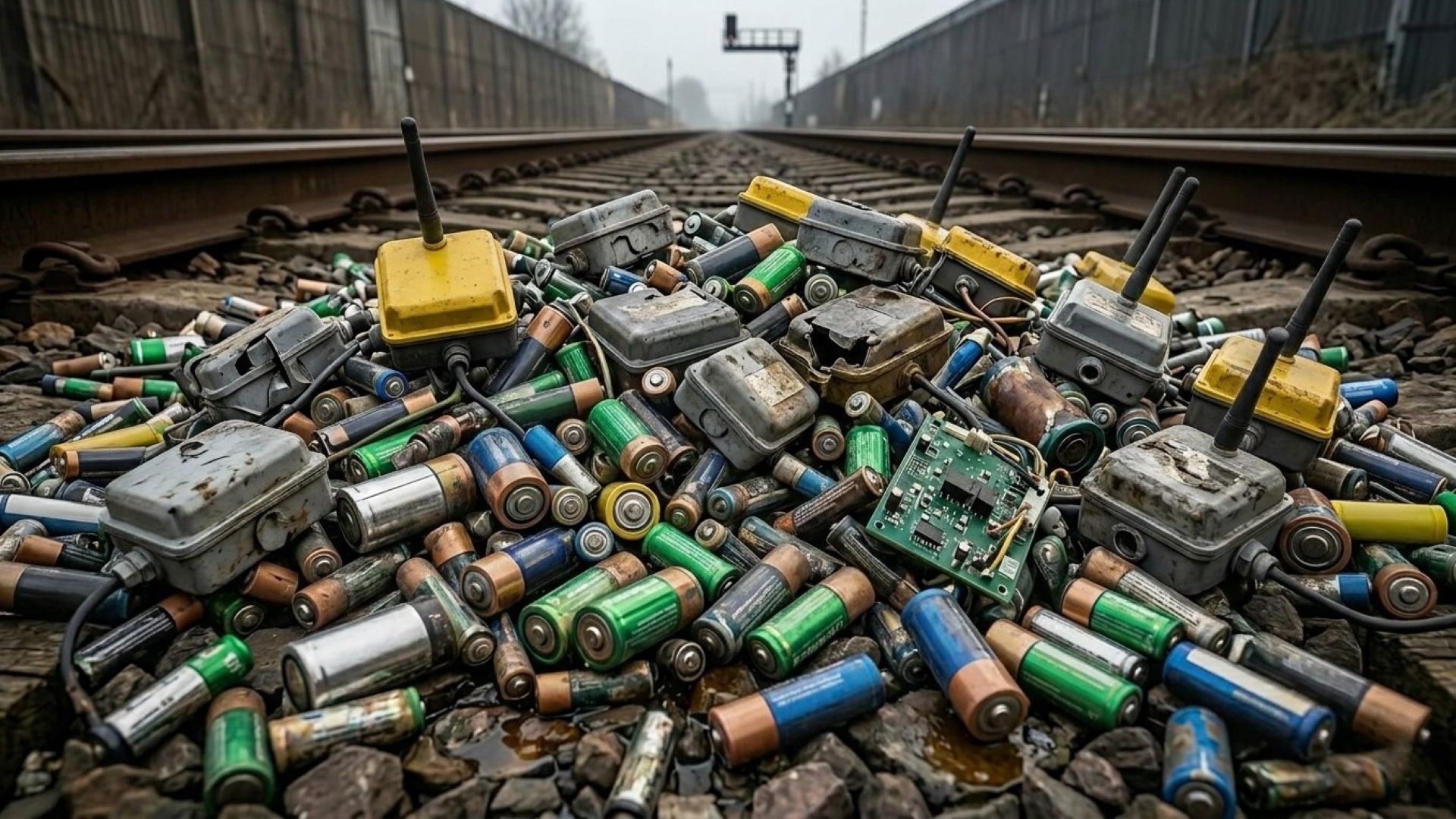
This type of equipment, when configured for Network Rail slope monitoring applications, is mounted on steel spikes every 2 metres along the base of the slope. The position of the sensors is recorded at intervals.
Sensonic infrastructure monitoring uses continuous fiber optic cable located along the base / toe of a slope, usually below ground level rather than a line of discrete sensors.
The fiber provides a continuous "gap-less" sensor, typically tens of kilometers in length.
Data is continuously monitored from the entire fiber at a typical frequency of 2000Hz, i.e. Two thousand measurement pulses per second. This measurement frequency is in sharp contrast to intervals between measurements of many seconds, minutes or even hours commonly found with IoT-type sensors.
Movement of the sensors is recorded by the monitoring system as four colour-coded levels of alert, of which the highest two are considered to represent significant movement:
1. Green (information) – movement of between 10 and 30 mm
2. Amber (major) – movement of between 30 and 60 mm
3. Red (severe) – movement of between 60 and 90 mm
4. Black (critical) – movement of more than 90 mm
Around 4 hours before the accident, the sensors nearest to the landslip began to show minor movement of the earthwork, below the threshold needed to trigger a green alert. This movement continued for the next 2 hours, remaining below the green alert threshold.
At around 04:30, when the evidence available to RAIB suggests that the landslip occurred, the two sensors in the path of the debris were tipped over and subsumed by the material sliding down the slope. It would appear that this occurred too quickly for them to determine and transmit their movement and to generate an alert.
Sensonic Distributed Acoustic Sensing (DAS) systems detect rapid ground movement from the vibrations they generate (rather than measuring absolute or relative displacement or tilt). Our landslide detection system are therefore sensitive to rapidly evolving events/movements. The 2000Hz measurement frequency makes it practically impossible for a ground movement to happen too rapidly to detect.
RAIB has further concluded that the sensors’ wireless signal was also unable to pass through the layer of material which covered them. This is based on them being able to re-establish a connection and report a variety of alert levels as the site was cleared.
Sensonic DAS systems do not use wireless communications for sensing purposes. This means they are not subject to external communications signal interference or attenuation e.g. material/debris covering the sensor. Our sensing fiber is normally located below ground level.
As long as the fiber remains intact, multiple events may be detected spread both geographically, (along the monitored route), as well as spread over time at the same location, i.e. Our equipment remains operational during and after a slope failure - a reset is not required. Should a fiber be broken by gross ground movements, then a high priority alarm and location of the fiber break is instantly raised.
Sensonic Summary
The landslide and subsequent derailment at Shap in cumbria, UK exposes vulnerabilities that exist across the rail industry when using IoT type sensors to report on remote asset condition and in particular their use to detect rapid events such as landslides / landslips.
The lower update frequency of measurements from IoT type sensor systems, (necessary to deliver good battery life), may not be compatible with capturing rapidly occuring events such as the landslide/landslip observed. The sensor technology reliance on intermittant broadcast updates appears to have led to multiple sensors becoming disabled before they could deliver their update/alarm rendering the detection system blind to the landslide.
As these and similar remote sensor systems have gained recent popularity across the UK and elsewhere, this now leaves many rail operators and maintainers with an unexpected gap in their remote asset monitoring capabilities. A gap which distributed acoustic sensing is well placed to fill.
Want to find out more about our landslide or rockfall detection?